Post-surgical entertainment round-up Pt. 1
Dispatch from my bed

On Wednesday I got the bunionectomy that doctors have been suggesting for a decade; I, along with half a million other New York residents, will lose my affordable health insurance soon, and my big toe joint was becoming arthritic as well as increasingly, unsettlingly mobile. So, I guess, YOLO. I’m so excited to go shoe shopping once I’ve full recovered, but that won’t be for about eight weeks. Most of that time will be spent clomping around in a surgical boot. This week I’m basically bedridden.
Book-wise, I’m making my way through Jane Hobhouse’s elegant and troubling (to me, anyway) 1983 relationship novel, Dancing in the Dark; and rereading Nick Toches’ perfect Jerry Lee Lewis biography, Hellfire. I’ve been watching a lot of movies, which I’ll detail below


Before going to the hospital, I spritzed a little Ffern Winter 26, a generous gift from my dear friend Rachel. It’s a dry and cool bend of spice, balsam, mimosa, oakmoss, violet leaf, seaweed, eucalyptus and lemon, and though I normally prefer to smell a little more like overripe fruit during the summer months, this is too pretty to save. My sense was that it would be perfect for a climate-controlled hospital and I was right.
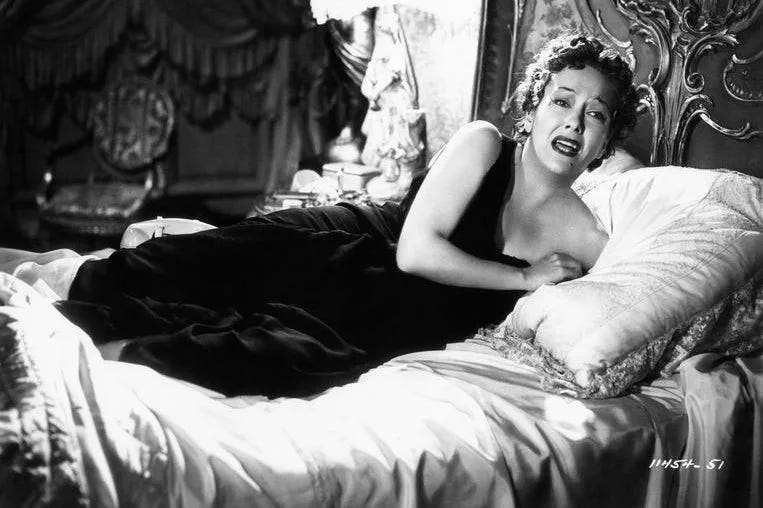
Back at home, trying to channel Norma Desmond, I’ve been reaching for hot ‘n’ heavy vintage bottles including Fracas, Loulou, Paloma Picasso. The latter two came out after Gloria Swanson died (not long before I was born, coincidence? Or…). While she was alive her favorite perfume was Le Fruit Defendu, which is no longer in production but smelled, according to historian Lizzie Ostrom, of “golden, stringy caramel, with the added boozy peach syrup of a bellini.” I bet she liked Fracas too, which is about as lush and juicy and delicious as a white floral can get. With the perfect sleep of general anesthesia still in my recent memory, maybe there’s something about Fracas that rhymes with that sensation. Maybe that’s why Courtney Love adores it!
G.I. Jane (1997)
I’ve aways “wanted” to see this, but not enough to actually go to the trouble of sitting down and watching it. We waited in preop for six hours and I channel surfed, groaning during the Burger King commercials. The soda splashing out of cups suggested too much refreshment, the burgers looked too delicious. They finally hooked me up to an IV to deliver fluids and glucose.
Anyway, this was the perfect pre-surgery movie because it’s all about withstanding pain and not being allowed to eat. I loved Viggo Mortensen, tan and leggy in short-short khakis, poetic, canny, sadistic but, in the end, decent. Moore’s famous head-shaving scene — long burrowed into my subconscious because it’s in the trailer — is giddier than I’d assumed. I suppose I don’t have much to say on the concept of women in combat, and I can’t say Ridley Scott swayed me in either direction, not that he necessarily intended to. There’s a quaintness to the fear of scandal at the heart of the plot, but on the other hand, in the age of an even more racist and sexist “Department of War,” this might be due for a little rage-bate clip-mining. Moore asks, semi-rhetorically, is a woman’s life more valuable than a man’s? Does a woman’s death cause more pain? IDK, it seems like the modern gender debate leans closer to the question of whether women’s lives are worth much at all.
Men (2022)
I recalled this getting bad reviews, but I was feeling generous, and I figured that I could use this recovery time to watch things I normally wouldn’t. Harper (Jessie Buckly) rents a house in the English countryside where she plans to regroup after the death of her unstable husband. The nearby town is, with the exception of a nice policewoman, populated by sinister men, all played by Rory Kinner, hammering home the point that all men are the same, and they’re all dangerous. I couldn’t for the life of me remember the writer/director of this surreal folk-horror tale, so I looked it up halfway through: Alex Garland. Well, that explains the smug, incoherent tedium. As with the misguided Civil War Garland takes big, self-important swings, but seems to be doing so with his eyes squeezed shut. There are twists and turns, and I never knew what would happen next, but in a boring way. Why did Garland think he was the person to tell this story? There’s a certain kind of man who apologizes to women for his gender, and that’s the kind of man you have to watch out for.
Knives Out: Wake Up Dead Man (2025)
I watched the first Knives Out movie in a cabin in the woods during lockdown, probably the ideal viewing situation for a clever ensemble murder mystery. I skipped the second installation, being more interested in the cozy country parish setting of WUDM, and a cast that includes Josh O’Connor and Josh Brolin as oppositional priests. Brolin, a reactionary conservative, maintains a small, ragtag congregation of archetypal weirdos, whom he controls with self-serving fire and brimstone. When the murderer inevitably strikes, O’Connor, a reformed bad-boy and true believer in the Love of Christ, reluctantly teams up with Daniel Craig’s rationalist detective Benoit Blanc. I once heard someone complain that Agatha Christie cheats the reader by withholding information crucial to solving the case, and the same is true here, though I didn’t feel particularly cheated, as I could never even solve the cases of Encyclopedia Brown. As critic Brian Tellarico points out, Rian Johnson doesn’t make who-dunits so much as WHY-dunits. It’s a ripped-from-the-YouTube-thumbnail critique of Trumpian extremism, but anyone familiar with the trajectory of the church over the last many decades will recognize that WUDM mines something deeper. I cried!
First Reformed (2017)
Another movie about a well-intentioned priest with a guilty conscience, watching in horror as his church is steered by right-wing interests. Different tone, entirely. First Reformed feels like it’s shot entirely under a heavy, waiting raincloud. Ethan Hawke’s Rev. Toller counsels a depressed young climate activist, which sends him into a crisis of faith. I love this movie so much that I had barbed wire tattooed on my shoulder in tribute. I put it on because my boyfriend had never seen it, five minutes in he was fully asleep.
Palindromes (2004)
Once, when I was 15 or 16, my friend Amy and I were cruising around in her car. Ben Folds Five’s “Brick” came on the radio. “I heard this song was about an abortion.” Amy said. “Huh,” I said. “For or against?” “Neither” she said, ‘It’s just about it.” I was dogmatic, as most young people are, and such a possibility had never occurred to me.
Todd Solondz’s surreal comedy Palindromes is “about” abortion, though Solondz would probably clarify that it’s “about” the characters, and how they respond to various circumstances, in this case an abortion. Young Aviva runs away from home after being forced by her parents to terminate her pregnancy. Alice-like, she takes a series of subsequent misadventures in stride, eventually finding herself with a family of anti-abortion activists. Aviva is played by nine different people of various ages, races and genders, each echoing the others’ soft, high voices, Aviva’s one consistent trait.
Palindromes came out around the same time as another abortion movie, Mike Leigh’s Vera Drake. The hero of Leigh’s film was clear. Palindromes left audiences with less certainty about whether it’s writer and director had the correct view. “I am not interested in creating work that reinforces beliefs that audiences already hold dearly,’ Solondz told Interview Magazine last year. “I think I’m much more drawn to certain kinds of contradictions and challenges, to the way in which we take in these irresolvable issues, because abortion is irresolvable.”
I went through a major Solondz thing a few months ago, and I’m endlessly amazed at his ability to walk that razor thin line of un-resolvability, balancing ugly transgression with a strange suburban coziness. Horrible actions and inevitable consequences are tied up in unsettling little packages. The anxieties he unflinchingly explores are unsettling because they are familiar. This reads, to some, as misanthropy — audiences are often unsure how to digest the way in which pain is mined for laughs.
It’s clear to me that Solondz loves his characters. He gives them agency and dignity. To paraphrase Solondz’ friend Sigrid Nunez, even his most infamous characters are treated with compassion, they’re “allowed to fall to the very bottom, morally speaking” but they never lose their humanity.
You shouldn't be losing your affordable health insurance. I'm pissed!
Loved WUDM and still have FR on my list! I won't fall asleep. I love a handsome priest with a heart full of mysteries.