In Dreams
Singer-songwriter Kyle Hamlett digs into the psychic underworld

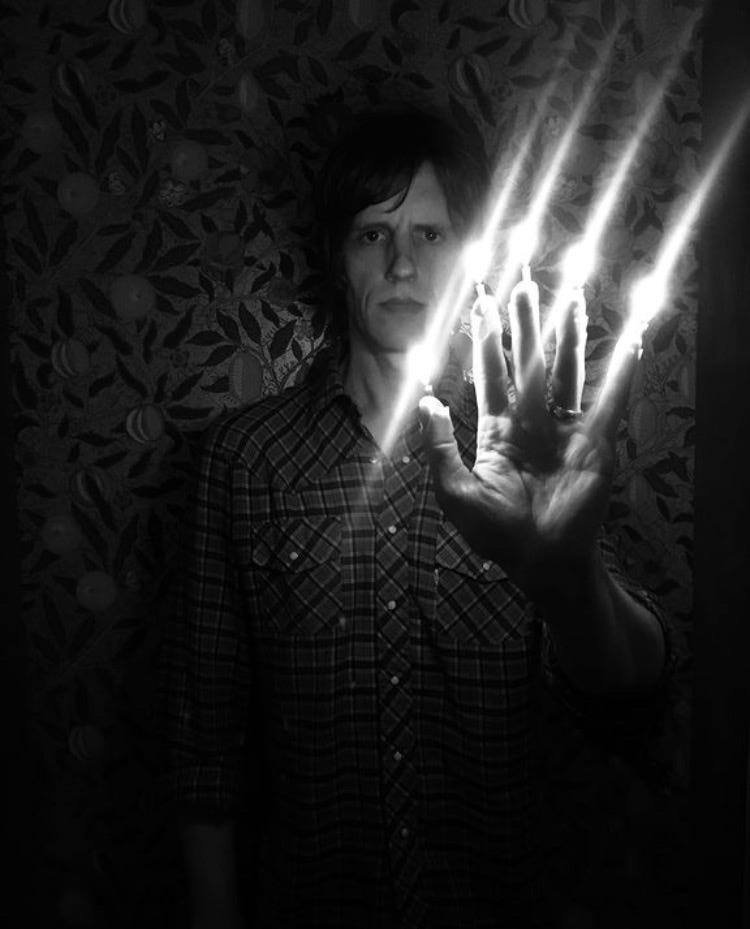
The night before my phone conversation with Nashville-based singer-songwriter Kyle Hamlett — this was some weeks ago, now — I dreamt of trudging across a muddy soundstage, of getting clobbered by ocean waves in a swimming pool, and riding over cartoonish hills in the backseat of someone’s hooptie.
Politeness generally dictates that one does not describe one’s dreams to others, especially not to strangers, as not to bore them. I told Hamlett about it anyway, since it felt like his new solo record, The Way Out Inn, had bled through to my inner mind.
Hamlett, it turns out, is very interested in dreams, he writes them down when he wakes up and occasionally poses questions to his subconscious before he goes to sleep. “Dreams do end up meaning a lot to me,” he says. In the moments where one might start to spin out on rational, conscious thought, the archetypal language of dreams can be an antidote, or at least an alternate route: “Your dreams might deliver you a message in a coded way that’s telling you exactly what you might need to do,” Hamlett says. Sometimes, for him, these messages are direct.
“I’ll get almost — not text messages — but sometimes the dreams won’t have any other real content aside from…” he pauses to think. “Well for one instance, I had a dream that just said, ‘Listen to Laurie Anderson’s “Strange Angels.”’ He laughs. “So, I got up and listened to it and there was a line that was speaking to something I was going through at the time.”
Though Hamlett only recently started consciously incorporating these messages into his songwriting, his music is frequently described as some variation of “dreamlike”; To my ears it sits closer to pre-slumber hypnagogia, the state where we begin to twitch and reality becomes elastic, but thoughts still feel lucid. The Way Out Inn — released under the name Kyle Hamlett Uno to distinguish from other projects (Duo, Trio, Cinco) — follows its own mysterious logic. Songs unfold via signifiers both mundane and mysterious, with an unhurried disregard for linear narrative, and the slightly dispassionate observational narration of a man in no big rush to put together the pieces.
Hamlett was confronted with metaphysical uncertainty early. He was two years old when his father got sick, four years old when he died. “So, there was this mystery that was immediately thrust upon me and my brother, who was two years older,” Hamlett says. “We were like, woah, what’s this? What happens when you die?”
He wasn’t particularly satisfied by the answers provided by the Church of Christ, the conservative denomination to which his family belonged. More profound was the drive to and from church, during which his mother tuned into a local radio station’s “Beatles Brunch.” Hamlett, his imagination already fueled by the colorful fantasies of comic books, gravitated towards the band’s more psychedelic efforts, and John’s songs in particular.
“One of my favorite things is to have a lyric almost immediately contradict itself,” Hamlett said in a 2022 interview. “I’m thinking of The Beatles’ ‘Revolution,’ when John Lennon sings, “You can count me out–in.” … [It’s] such a bold anthemic statement, immediately undercut in a way that somehow gives it more gravity to me.
“I very rarely trust absolutes,” he added. “The grey areas are always more interesting.”
As a budding guitarist, Hamlett was inspired by bands like Guns N’ Roses and Nirvana. The latter in particular sounded revolutionary to his ears, “so good and mysterious” and, of course, totally punk to the extent that the band was operating in a way that seemed, Hamlett says, “human-sized, doable. Like, oh that’s a way I could put something across.”
Like Lennon, Cobain could be sensitive and soulful, but also ferocious and contradictory. Hamlett liked digging into Cobain’s lyrics. He felt like he was trying to get in between the words, not knowing if there was even a fixed meaning to discover, “which was just as satisfying as if it [had been] presented as a direct message,” he remembers. “More satisfying, because you’re kind of participating in it.”
Growing up outside of Nashville instilled him with an allergy to country music, and as younger man he and his bandmates joked that they just wouldn’t tell anyone where they were from. “I hate to admit to being reactionary,” he says, “but that was the way it was …I rejected a lot of it for a while because it was so omnipresent and didn’t sound like something that I ideologically or sonically aspired to.”
He came to his own finger-picking guitar style in a round-about way, one influence being David Grubb’s delicately moody post-rock guitar record The Spectrum Between (2000). “I’d never heard anything like it,” he says of that record’s brainy, avant-DIY approach to a fingerstyle more associated with traditional blues and Americana. “I started kind of trying to get my fingers around similar sorts of ideas.”
Robyn Hitchcock — himself kinda Lennon-esque vis-a-vis lyrical contradiction — was (and remains) another major inspiration: His way of structuring stream-of-consciousness surreality within traditional pop and folk formalities felt dreamlike to Hamlett, and he took it as permission to do the same.
Hamlett would eventually soften on country music, coming to it by way of Uncle Tupelo and Lemonheads covers of the Louvin Brothers. His fingerstyle is folky and kaleidoscopic in contrast to, say, Grubb’s more muted sound; His songs are technicolor American tall tales in contrast to Hitchcock’s English cock-and-bull stories. His voice stays forward in the mix, lending a sense of intimacy and immediacy. For this, Hamlett credits producer Joe McMahan, “[he’s] a big song-and-vocals guy and wants that to be upfront and let the lyrics tell the story even if the story is nonlinear and obtuse.”
Album opener “Fools Moon,” kicks off with a wobbly-wheel riff, over which Hamlett casually octave-hops, relaying a surreal series of events: A leak turns into a wave, a floor resigns; a witch arrives at a wake and speaks only to the dead. Track by track tension pleasingly builds and then relents. “Empty Senses” veers close to something like “new wave,” grooving and swaying as Hamlett croons placidly over a background singer’s spectral “ah”s. The lilting slow waltz pace of “Stardust Street” slightly obscures its Mephistophelean imagery. Instrumental “Low Star Ramble” arrives midway through like an inherited half-memory of an intermission between episodes of Howdy Doody. These songs share a sing-along-ability, a music-box simplicity. But they pull the listener deeper.
McMahan — who has worked with KD Lang, Allison Moorer, Shelby Lynne and Leanne Womack, among others — also contributed an array of instrumentation, including but not limited to guitars (both electric and acoustic), keys, mandolin, lap steel, kalimba and melodica. The Way Out Inn, with its eerie chamber-folk production, emanates a shifty, unreal kind of sensation.
“Joe took it even further out than I expected,” Hamlett says. “His brain is really cool and weird, he’s mostly played with Americana and blues artists but he’s really into far-out no-wave stuff and free jazz; [the] things he would hear and push the song towards surprised me, but in a really good way. I think it wound up taking it into a vaster place, wilder sounding.”
Hamlett wrote most of this record during the pandemic, a time when the relationship between inward and outward developed certain acute complications. “I had these songs that I guess I felt were trying to travel a little bit. Like they were trying to describe different locales … I was thinking about the desert and open space a little bit. Both like terrestrial space and outer space,” Hamlett says. But — like ocean waves in a swimming pool — it was about inner space, too. “I was imagining a little room or structure where all these songs would live and be played, and some little phantom house band would be playing these songs around the clock.
“But also, the way to get the furthest out is just to go completely inward,” adds. How dreamy is that?