Good Vibrations
Thoughts on manifestation, Calvinism, the gig-economy, America, and more.

This summer was pretty lean, financially speaking, but summers usually are for me. Members of the downtown NYC hot yoga studio I manage go to the Hamptons or to Europe for the summer, and those of slightly less impressive means are perhaps disinclined to spend hot days in a 105-degree room. Work slows down, classes get cut, and I’m faced with the eternal dilemma of more time to spend money, and less money to spend.
Every year I decide to “make frugality fun.” In the past I’ve posted requests for people’s money-saving tips, but last year I finally realized that I know all the money-saving tips already. I make coffee at home. I “shop my closet.” I go to the library. I carry around a bag of almonds and a Nalgene bottle. I sneak beer into the movies and only get popcorn if I have enough Regal points (6000 for a small).
A couple years ago, a couple cocktails deep, an older, wiser yoga colleague told me that she thought I had a “scarcity mindset.” I bristled at what I considered pop-psychology terminology but I also felt that she was correct. Being broke has long been part of my identity, both when it’s true and when it’s slightly less true. As a high school friend once put it in a mildly hurtful impersonation, “I’m Margaret and I never have any money!”
Sometimes I think I’m a chronic under-earner because the system is rigged. Other times I believe that (in addition to the system being rigged) money simply isn’t “meant for me.” The law of attraction, however, posits that I can’t receive something that I don’t (yet!) believe I deserve.
My colleague’s observation is to be expected in the “wellness space” in which I work, but the language of manifestation and magnetism is everywhere these days. It makes sense: Most of the people in my life have never felt more financially strained, less in control, or more concerned about the future. The idea that you can shift your energy to more easily attract the things you want — usually love or money or something related to one of those things — is obviously tantalizing.
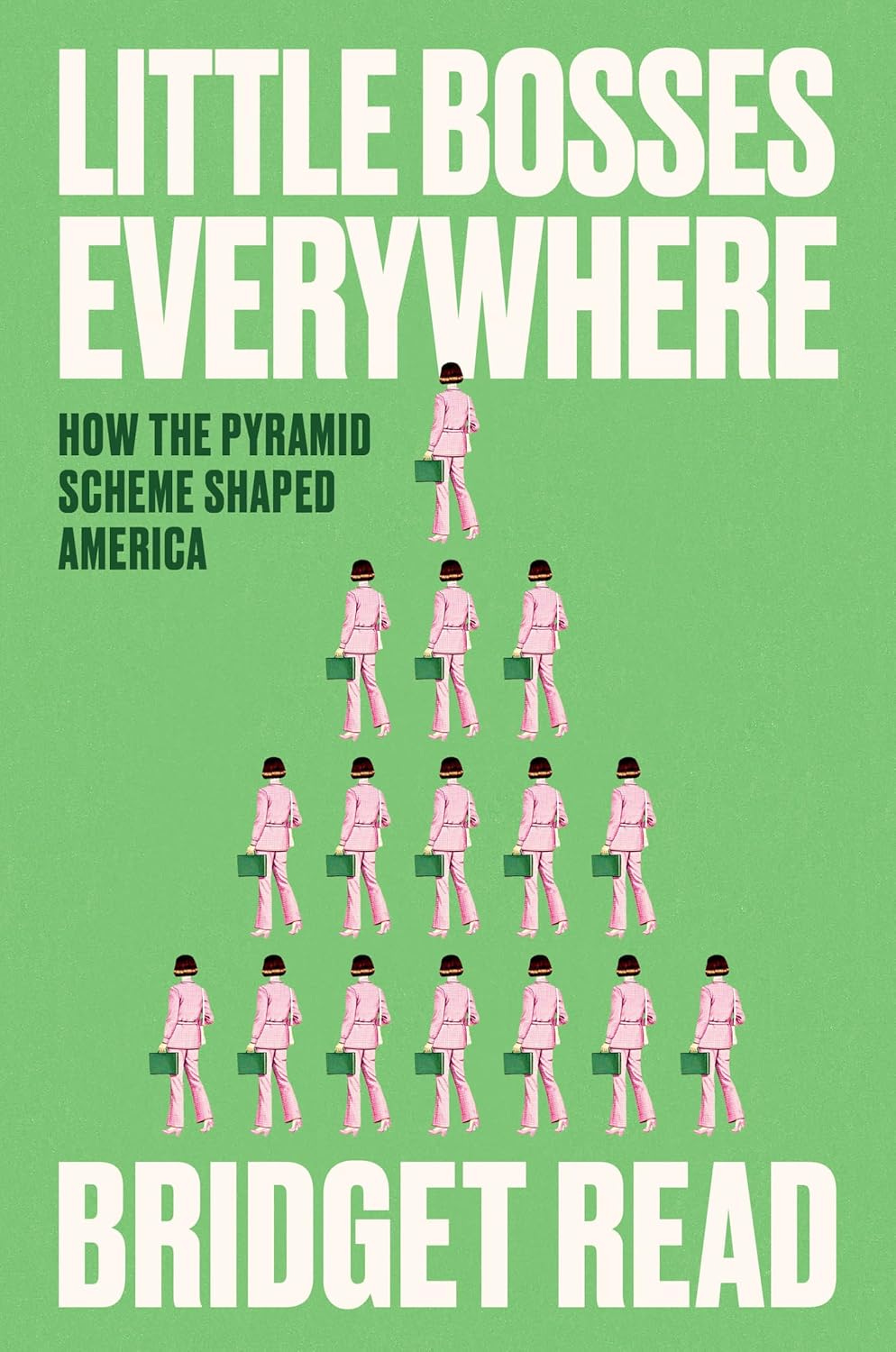
I just read Bridget Read’s Little Bosses Everywhere, which charts the rise of multi-level marketing. Direct-sale companies like Amway, Herbalife and Mary Kay rely on aggressive recruitment and a … let’s say … triangle-shaped business model. Filled with stories about false hope, financial ruin and team-building exercises that recall Succession’s “Boar on the Floor,” Little Bosses Everywhere could be adapted into a horror movie. (Beware the Amway Pod People who lurk on Bumble).
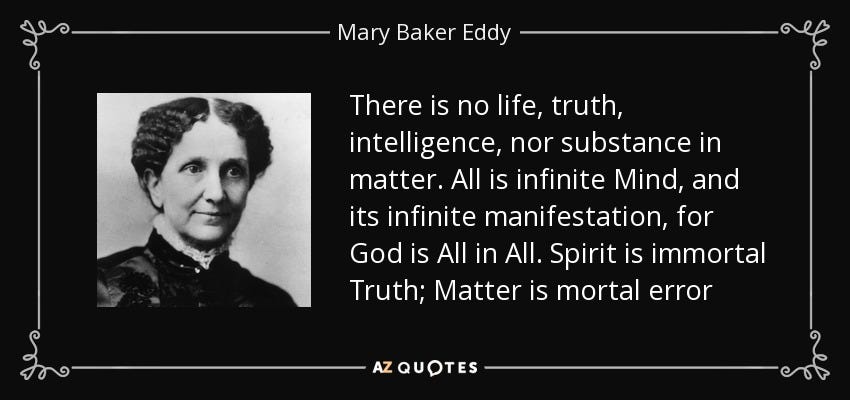
Critical to the proliferation of these pyramid schemes was “New Thought,” an idea pioneered in the 1870s by Theosophical Society co-founder Helena Blavatsky, and Church of Christian Science founder Mary Baker Eddy, among others. New Thought, in essence, dealt with energetics and the law of attraction. Good thoughts attract good things, and miserable thoughts attract misery, so you’d better accentuate the positive and focus on what you want.
The Gilded Age brought with it overwhelming changes to the American labor market and society generally, and within these conditions New Thought flourished. “It assuaged people who no longer knew where exactly they would fit into new industries, new cities, new futures,” Read writes. A few decades later, in 1937, Napoleon Hill’s Think and Grow Rich informed readers that wealth was all about harnessing (or attracting) universal vibrations associated with money, and by extension becoming a magnet for cold hard cash. If you visualize money every day and replace negative thoughts with self-affirmation, the subconscious mind will operate on positive autosuggestion, which can be set into motion with clear goals, planning and decisive action.
“Hill was speaking directly to the anxious masses who were still reckoning with the worst years of the Depression and who were delighted to learn that they could train themselves out of poverty and worry,” Read writes. Similarly, Protestant minister Norman Vincent Peale capitalized on post-war malaise with his 1952 book The Power of Positive Thinking.
Peale had been an opponent of the New Deal which he felt unjustly rewarded the unemployed and provided help to those who didn’t deserve it. ‘We all get what we deserve’ is, of course, a convenient theory, especially when you’re up. It’s also the perfect answer to those struggling to make their little MLM ventures (and side hustles generally) work. It’s not the business model that’s the problem, it’s your attitude. To succeed, repeat your positive affirmations, put on a big smile, and get out there and say whatever it takes to make a sale.
I found it somewhat curious that Peale was a Calvinist, since the foundational Calvinist tenant of predestination — the doctrine that God has eternally chosen those whom he intends to save — would seem, to me, to clash slightly: Presumably any stickler would agree that if God has already decided (for one prime example) not to save you from eternal damnation, no amount of positive thinking will change that. As with those manifestation practitioners who imagine that their future selves already have what they want, the time-space continuum becomes slippery.
My introduction to energetics was Rhonda Byrne’s The Secret which I’ve never read, but absorbed to some extent via cultural osmosis. In those days there were a lot of Evangelicals in my orbit, and a fair number of those were no-nonsense Calvinists who denounced The Secret as stupid at best and, at worst, dangerous as it warped Matthew 21:22, “Whatever you ask for in prayer with faith, you will receive,” turning it a kind of spell.
Like Bruce Wilkinson’s Y2K prosperity gospel blockbuster, The Prayer of Jabez— which frames a previously un-famous passage from 1 Chronicles as a mantra — God is, to borrow the phrase of one critic, “Santa-fide.” Be good and use the magic words and you’ll get whatever you want. Of course in reality, many Evangelicals are, when it comes down to it, as superstitious about the energetics of language and thought as anyone else. You’ll see this if you, in the wrong company, misidentify God with such New Age-y honorifics as “Source,” “the Universe” or “She.”


Looking at our present Geo-Political “situation” it might seem as though we have only God (or the Universe/Source/Cosmic Bootstraps) to look to for help. Whether or not that’s true, this conclusion is pretty much the point of long-term political projects executed by Neo-Cons and Neo-Libs alike. If it’s all about energetics — if we all get what we deserve — we don’t need a social safety net, or FEMA, or vaccine mandates, or gun laws, or anything that might presume that anyone deserves any kind of protection or support by virtue of being a human being. As Read details, this anti-democratic project of precarious hyper-individualism has been directly advanced by high-level executives working in the most predatory MLMs.
New Thought is deeply entwined in American life generally and Trumpism specifically. Fred Trump was a fan of The Power of Positive Thinking and internalized it’s message: “Picture yourself succeeding, avoid ‘fear thoughts.’” His son Donald later claimed that Norman Vincent Peale called him his “greatest student of all time.” In the face of failing business deals in the 1980s and '90s, DJT said he “refused to be suckered in to negative thinking on any level, even when the indications weren’t great.” It goes without saying that others eat the cost of his alleged positivity.
Modern manifestation gurus take a more therapeutic approach and focus less on white-knuckling positivity, though positive affirmations and visualizations, coupled with goal-setting and action-taking, remain central practices. When I was a kid I heard a sermon from a preacher who said that the point of prayer was not to get stuff from God, but to become more aware that God is the source of everything. Prayer and manifestation are resemblant concepts. As you build genuine awareness — as you “trust the process” — you’re able to accept and appreciate the cosmic gifts you might otherwise have not even noticed.
Lacy Phillips, founder of the popular manifestation brand To Be Magnetic, believes that the key to getting what you truly want is a deeply-held sense of high self worth, which can be developed via her system of guided meditation and self-hypnosis, which “unblocks” “limiting beliefs.” As the practitioner identifies these limiting beliefs, she clarifies her goals, enabling meaningful action. The more “aligned” her actions, the more authentic her desires, the more easily she can harness natural magnetism by becoming unencumbered by fear and the angst of unrealized potential. We all know people like this: Widely beloved, joyfully supported, fully themselves. In other words, when you’re following the plan set for you by the Universe (et al), you’ll always land on your feet.
A little spiritual knowledge can be a dangerous thing, and the gig economy puts that into hyperdrive. The internet is full of would-be Blavatskys and Baker Eddys, peddling their services as mystics and healers and “coaches” offering various modes of spiritual and energetic guidance. Many of these practitioners are, I’ve noticed, inexperienced in their fields but anxious to monetize their relatively new passions. Knowledge gaps can, after all, be filled by ChatGPT.
One of Read’s subjects is a former Mary Kay lady named Monique. After years of struggling to make her business succeed she finally cut her losses — that is, the money spent on unsold products, trainings, and other business expenses — at $15,000. Another Mary Kay associate recommended her a financial coach, Ross, who worked with MLM distributers to help them pay down debt and unload extra stock. Monique paid Ross thousands of dollars for his assistance. He then convinced her to spend another $18,000 on a year-long program to help her become a real entrepreneur, but most of the business ideas he pushed involved Monique becoming a “coach” herself. She dreamed of starting a support group for women veterans; Ross and his team told her she should charge $1,200 for her services. Monique told Read, “How can I dare get in front of those veteran women talking about, ‘Hey, I battled this and I battled that, I ain’t got no training, but let me be your leader here. Pay me a gazillion bucks.’”
In the self-care gig economy the concept of high-self-worth becomes weaponized. The coaches, Read writes, told Monique that “charging those exorbitant prices meant she knew what she was worth. She was setting her value in the world. The unspoken implication was that if she wasn’t willing to find … someone else to pay, she wasn’t worth very much at all.”
The question of how to appropriately thrive, materially or otherwise, in a world overwhelmed by suffering is fraught. As with any “self care” the justification is usually in the form of a metaphorical oxygen mask, and that’s fair enough. When I’m making enough money, for example, I’m profoundly relaxed and both materially and emotionally generous. And the self-knowledge that comes from therapeutic exploration makes life easier for me and by extension easier for everyone who has to deal with me.
On the other hand, self-care is just spitting distance from self-obsession and entitlement. Scarcity and terror are real for countless people who are too busy trying to stay alive to spend time unblocking their limiting beliefs. Anecdotally, To Be Magnetic seems to be rather popular in Israel. And as Americans, ourselves complicit (if unwillingly) in worldwide suffering and oppression, at which point does this become another opiate?

One of the rules of manifestation is that you can only manifest for yourself. You can, in theory, manifest a bigger paycheck and give all of it away, but you can’t manifest more money directly into your neighbors pocket. Like any tool it is, at it’s core, apolitical.
Despite the tangles, I do believe in energetics, magnetism, vibrations, and so on. (What can I say, I’m a yoga teacher!) After many years of pessimism and “negative self talk” I have to admit that a positive (or at least grateful) outlook does make things a lot easier, and less stressful, and does indeed influence material outcomes. I now actively try to resist my well-established scarcity reflex. Much like Fred Trump (I guess), I attempt to stay out of “fear thoughts” when I’m checking my bank account, or buying something I objectively need and can more-or-less afford. When I feel extra strapped, as I have lately, I try to shift that energy by giving away some amount of money every day, whether by tipping a little extra, giving a few bucks to whoever on the street happens to ask, donating to some worthy fund, or buying a coworker lunch. And so far the money has always, in one way or another, returned.
I am more open minded than I used to be, and I have lately come to a kind of spiritualism-under-protest, like the old woody allen (sorry) joke: to you, I'm an atheist, to god, I'm the loyal opposition. I don't know if I believe any of it but it feels boneheaded to dismiss it. Having said that, the positivity mindset stuff appeals to me for the same reasons you indicated: it's a choice I can actually make to experience life from the point of view of a lucky sap instead of a poor slob. The only downside is it sometimes feels inauthentic, but my authentic (always negative) beliefs about myself have never done me any good.
margaret! move back to Pgh! (jk) (not really) (i'm sure you have your reasons). this is deep and full. good stuff even though not about music. i have some other thoughts but they are coming slowly, so maybe i'll contact you later... thanks for getting my sleepy brain moving.